Capital runs down.
Every optimal plan drives capital and consumption toward zero.
Javier Milei / Demian Reidel
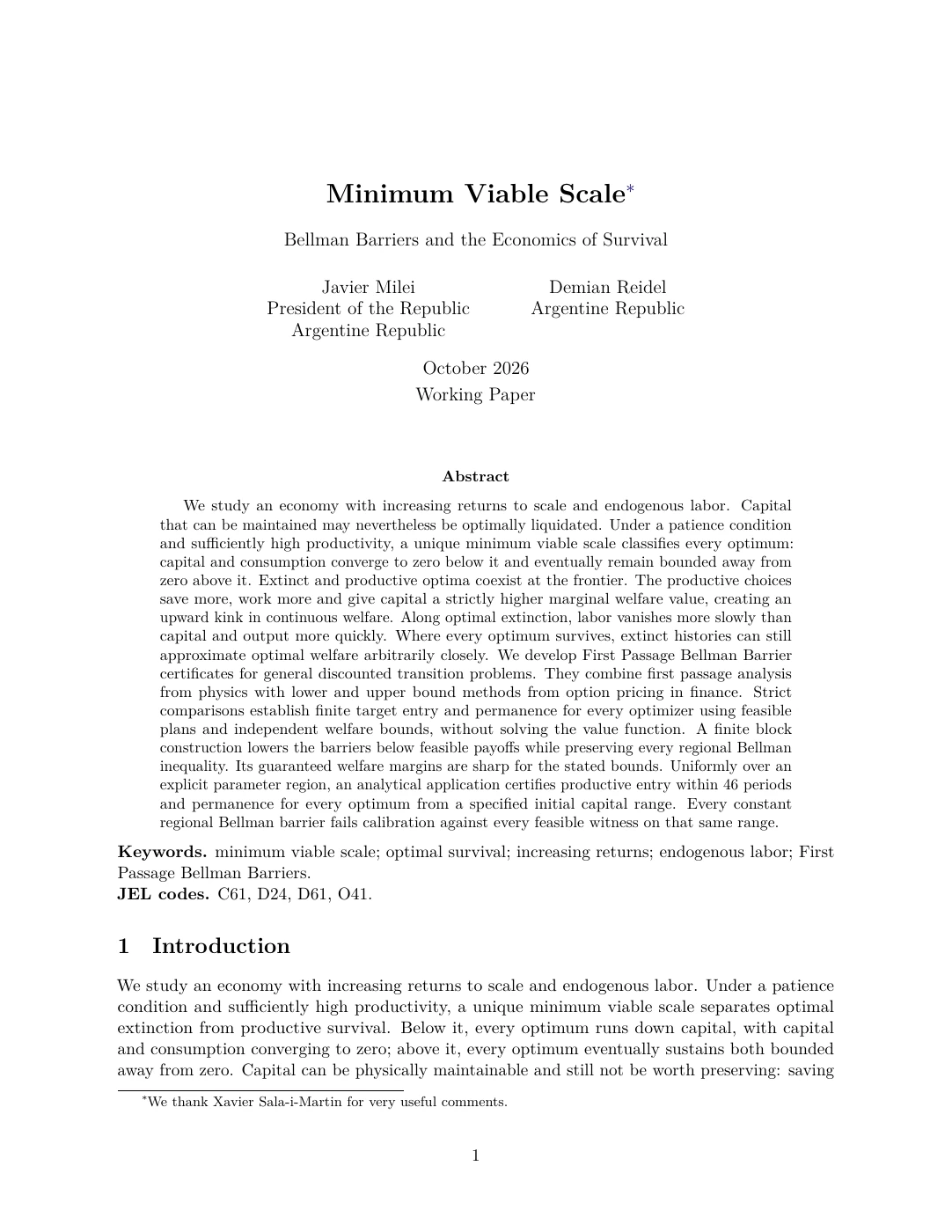
Bellman Barriers and the Economics of Survival
An economy can replace its capital.
And still choose to run it down.
Three results on which capital is worth preserving, its value at the threshold, and how to prove survival.
Maintaining equipment means giving up consumption and leisure. That sacrifice must be worthwhile. In this model, with sufficient productivity and patience, we prove that a minimum viable scale, S, separates extinction from survival.
The model. With increasing returns, expanding capital and labor by the same proportion raises output more than proportionally. A planner chooses consumption, work and saving to maximize welfare from consumption and leisure.
Every optimal plan drives capital and consumption toward zero.
Depleting capital or preserving a productive base: both outcomes are optimal.
Every optimal plan reaches a productive region and stays there, with capital and consumption bounded away from zero.
Between κ and S, replacing equipment is feasible. Yet depleting it is optimal. The economic minimum exceeds the lower physical maintenance threshold.
The curves illustrate outcomes; they are not computed paths. The result classifies every optimal plan when work and saving are chosen together. It does not require capital to converge to a constant stock. Conditions and proof ↗
V(K) is the greatest welfare the economy can achieve over time when it starts with capital K. At S, preserving capital and depleting it deliver the same welfare. But additional capital is worth more on the survival side.
Welfare is continuous, but not differentiable at S. Equal welfare does not by itself imply this kink. We prove that productive plans value additional capital more, even when either outcome has several optimal plans. Productive choices save more and work more.
Our method rules out paths that cannot be optimal, without solving the full model. We call it First Passage Bellman Barriers.
For each group of paths, we calculate a welfare ceiling: none can deliver more. If a feasible plan from the same starting point guarantees more than that ceiling, the group is ruled out. One example is plans that always keep little capital. The comparison covers their entire future, including recovery.
We use this comparison to prove that every optimal plan reaches a productive region and stays there. We combine first passage analysis from physics with methods for bounding option values in finance.
The rest is in the paper. The full model, capital losses, extinction laws and barrier construction, with their assumptions and proofs.
Bellman Barriers and the Economics of Survival
Milei, Javier and Demian Reidel (2026). Minimum Viable Scale: Bellman Barriers and the Economics of Survival. Working paper, October.
Assumptions, proofs and references in the full paper.
Back to top ↑